


Nomenclature
1. Introduction
2. Portable Solar Water Micro Pumps
2.1 Centrifugal pump
2.2 Positive displacement pump
3. Experimental Setup & Methodology
3.1 Performance evaluation of pumps
3.2 Selection of the solar water pumping system
4. Discussion
5. Conclusion
Nomenclature
AC : alternate current
DC : direct current
Esub : subsystem efficiency
G : acceleration due to gravity (9.81 m/s2)
H : Height (meter)
I : Current
M : Friction Loss
MPPT : Maximum Power Point Tracking
η : Efficiency
PSWS : Portable Solar Water Pumping System
PV : Photovoltaic
Q : Flow rate
ρ : Water Density
SPV : Solar Photovoltaic
SWPS : Solar Water Pumping System
V : Voltage
WTWE : Wire to Water Efficiency
1. Introduction
Portable Solar Water Pumping System are basically designed for fulfilling the requirements of small land holders as, compactness is an important requirement of such target beneficiaries. Impelled water can be used for various practices like livestock requirements for far-flung locations, irrigation of small fields, kitchen gardens and small farmhouses, etc. The impelled water can also be used to cater sanitation requirements in lavatories for convenient and effective utilization of solar energy and prevent water wastage. In this paper, characteristics, operating principle and practices of portable solar water micro pumping system (SWMPS) are described according to Indian requirements. The development of micro pumps started with piston type or reciprocating pumps1). Developing countries e.g. India, Sub Saharan Africa etc. have identified solar pumps as a climate smart technology to meet the growing irrigation demand2). Experimental Analysis and simulation study of solar powered water pumping system3) by optimizing the power conversion reveal the fact that, the performance of the SWPS is maximum at midday. The work presented in4), categorize the renewable energy source water pumping systems (RESWPs) into five different groups. The performance of each category i.e., biomass water pumping systems (BWPSs), solar photovoltaic water pumping systems (SPWPSs), solar thermal water pumping systems (STWPSs), wind energy water pumping systems (WEWPSs) and hybrid renewable energy water pumping systems (HREWPSs) highlight the vital role played by renewable energy source in water pumping applications and its environmental impacts. Energy consumption, water flow rate and crop water requirement are some of the significant aspects which are observed as per present technology and applications of solar water pumping systems5-8). Solar water pumping technologies have aided in mitigating reliance on the existing diesel or grid-based systems9). Optimization of multiple micro pumps to maximize the flow rate and minimize the flow pulsation has been discussed in10). Further, performance analysis of the pumps at different locations, for surface and ground water has been presented in11). The performance assessment and optimal sizing of the various commercially available pumping systems in Indian market based on has been included in12-13). The work in14) investigates the possibility of solar water pumping system for cassava irrigation in China and examines suitable area for solar water irrigation. A systematic approach for optimal sizing of photovoltaic irrigation systems has been discussed in15-16). The fact that, operating temperature plays a key role in photovoltaic systems and exhibits linear variations with respect to the output power of a PV module has been presented in17). The work in19), investigates the socio-economic changes and their impact on water management pertaining to the wavering energy and water demands. In Sub-Saharan Africa a new solar powered methodology is proposed for irrigation that can be utilized for the small-scale lands in remote rural areas19). Standalone solar powered water pumping systems are efficient and reliable approach to certain applications20). Motivated by such observations, governments have incorporated certain initiatives to achieve the electrification target for effective utilization of green energy sources21). Importance of SWPS for small land holders, pertaining to associated economic barriers restricting their ability to utilize such systems has been elaborated in22). The measures undertaken by Government of India by means of policies and schemes, particularly for women and underprivileged groups, in order to address these restrictions have been discussed in23). All these factors contribute in making SPV system, an economically attractive renewable technology25). The significance of operating heads on various SPV water pumping systems using optimum PV array configuration has been discussed in26). The effects of variation in irradiation, on the performance of SPVWPS has also been premeditated27). A cost sensitive analysis towards climatic conditions and geographical parameters is proposed smartly for system sizing and optimization28-29). The concept of centralized SPVWPS for domestic usage with emphasis on average water requirement has been investigated in30). Optimal photovoltaic arrangement to cater requirements of agriculturists has been included in31).
The work included in this paper introduces the concept of portable solar water pumps. The system employs an irrigation pump designed to meet requirements of the target beneficiary. For small land farmers in remote areas, portability is still an important requirement to address the threat of expensive equipment being stolen. Portable solar water micro pump systems intend to develop a plug and play compatible SPVWPS that can be carried by a person in hand/on a bicycle. The portability enables using the system at different locations/sites without much effort. The work provides analysis of systems employing centrifugal / reciprocating technology-based surface Pumps. Comparative study concluding DC Pumps to be more efficient than their AC counterparts has also been included.
2. Portable Solar Water Micro Pumps
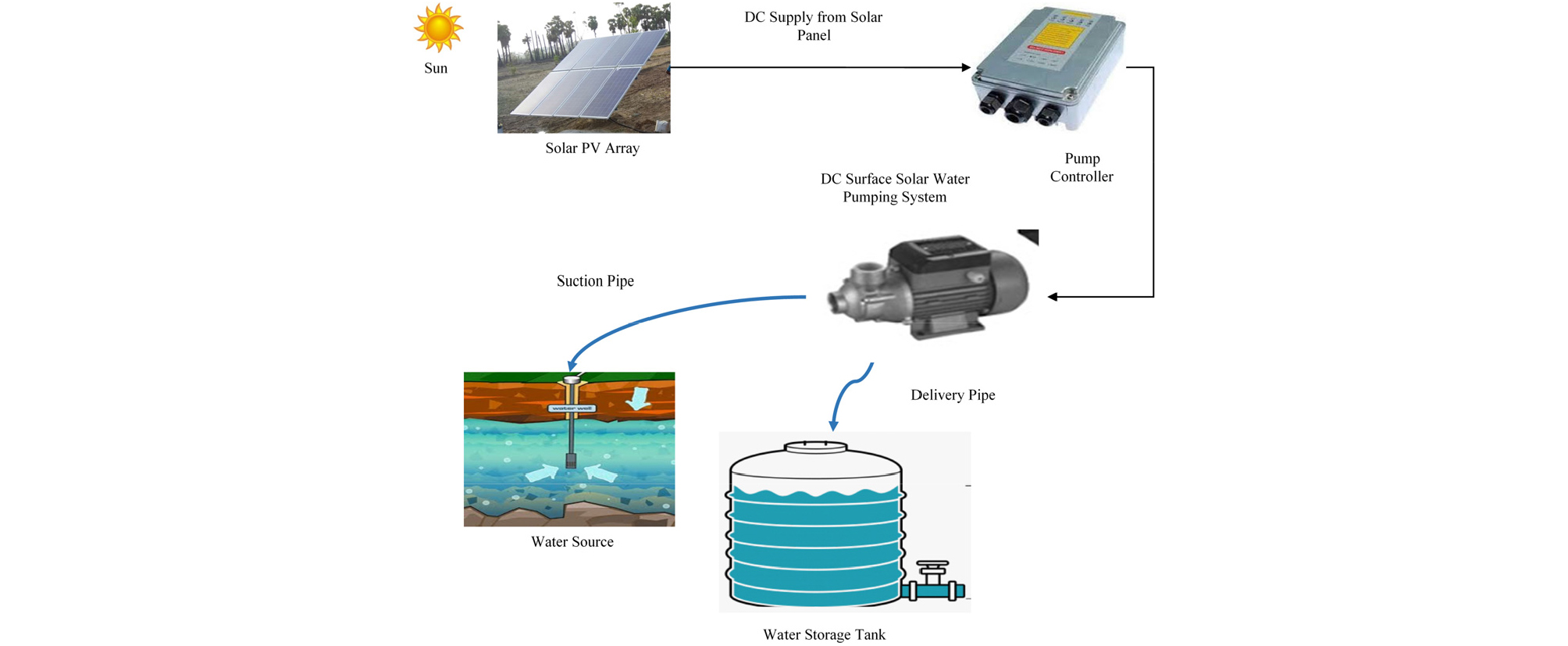
Pumps can be broadly classified into Surface and Submersible type based on their constructional features. However, portable solar powered micro pumps readily integrate surface type pumps, as these pumps can be operated by placing near the source of water (like river, lake or storage tank) to the field. Surface pumps are low-cost, high-efficiency pumps that require less maintenance and are easy to install.
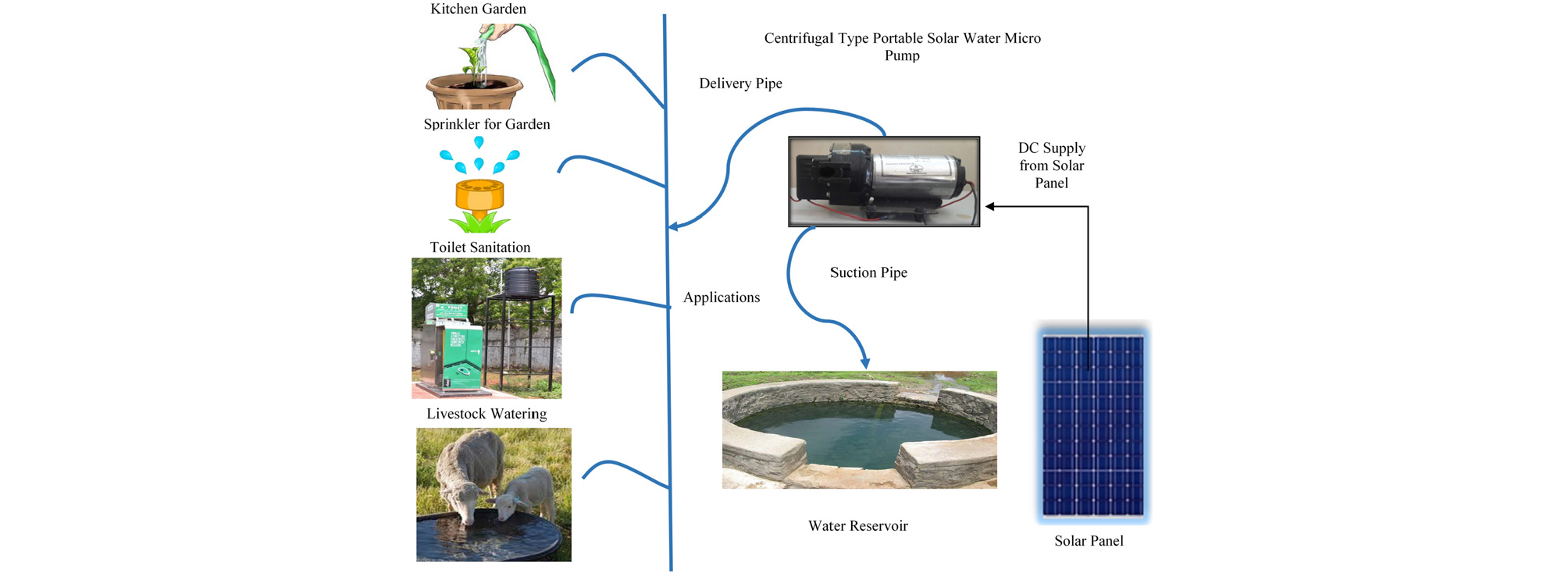
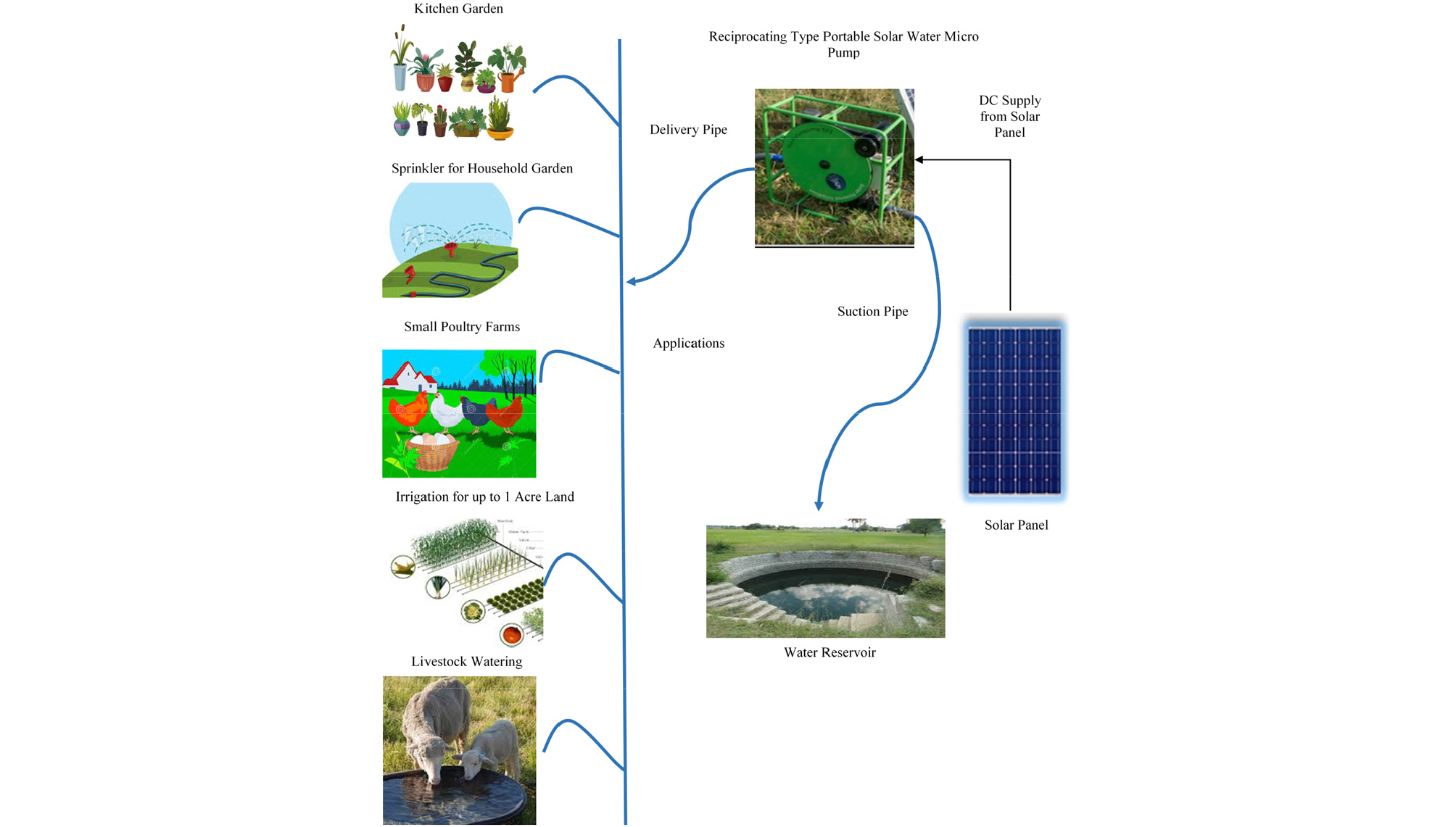
Surface pumps can lift water up to 8-meter maximum height for instance, surface type water pumping systems are adapted where water is required to drive from a dam or cistern to a storage tank on the field. There are three main technologies of solar water pump system given below in Fig. 2.


2.1 Centrifugal pump
This type of pump utilizes rotational kinetic energy to pull water. The pumps employ rotating impellers to impel water. The capacity of the pump is determined by the number of impellers employed. Multistage pumps are capable of achieving high output pressure and high rate of water flow. Water enters the impeller core axially and accelerated outwards by radial push of the impellers. Centrifugal pumps are most conventional AC pumps. However, the pumps required relatively high operating voltage to perform steadily. Therefore, performance is poor in cloudy weather, early morning and late evening when irradiation is relatively lower.
2.2 Positive displacement pump
This type of pump uses a piston to pump water, the displacement of water in positive cycle which brings water into a chamber and then forces it out using a piston. Piston-type pumps achieve high lifts and are capable of drawing water from relatively deeper ground levels. These pumps are relatively slower than other technologies but perform better, even in low power operating conditions. The major difference in operational principle between the two technologies is that, while the centrifugal pump utilizes rotational kinetic energy of impeller to pump fluid, the reciprocating pump is a positive displacement type pump. This enables the reciprocating pumps to handle even viscous fluids making them less sensitive to debris and other solid particles. Reciprocating pumps are generally ‘Farmer-Repairable’ (excepting DC Motor and Solar PV Panels). With a proper Remote Monitoring being installed, the System can provide advance intimation of pump-health to the Technical Support team. Having a practical suction capability of 8 meter with a total lift of 15 meter. It can be used to pump water from wide range of water sources - open-wells, lakes, ponds, canals, tanks, etc.
3. Experimental Setup & Methodology
The Solar Water Pump test facility established at National Institute of Solar Energy mainly consists of a sump well (10 m deep), Total head up-to 100 m and shut off dynamic head up-to 150 m. Which can create suction head from 0 to 7 meters for surface pumps. PV arrays of different capacities, mounted on suitable metallic structures conforming to the Standards specified by MNRE are installed for powering the pumps; the modules are configured in series and parallel to attain the required power output. Modules installed with SPV water pumping system are IEC 61215 and IEC 61730 Part I and II certified. Flow meters and pressure gauges are installed in the facility for a continuous monitoring of the flow and delivery pressure. The electrical output of these meters is automatically logged by the SCADA system which records all the parameters including the array-voltage/current, motor/pump voltage/current, radiation level both horizontal and tilted, module surface temperature, etc. on continuous basis, with periodicity of 10 seconds. The parameters are averaged over a period of 10 minutes and a data is stored in a memory as programmed. Two solar array simulators (Make: CHROMA) are deployed for simulating the array output power.
The performance of the system can be determined by evaluating the data acquired under varying conditions. The performance evaluation can be performed either under laboratory (replicable and reproducible) conditions through simulators, or under field conditions for acceptance test through outdoor PV arrangements. The programmable PV simulators are capable of simulating the necessary configuration (i.e., number of modules, type and required series/parallel combination) for laboratory test. The general layout of the system pipe work has been designed to avoid airlocks. For instantaneous performance testing, pressure can be sustained by means of a simple gate valve in which, a backpressure is sustained by restricting the flow. Separate valves were also deployed to sustain a constant upstream pressure (pressure sustaining valves). Necessary measures were practiced to counter the unpredictable performance of such valves. If possible, test laboratories may also sustain pressure by means of a pre-pressurized air chamber operating with a pressure maintaining valve at the outlet or a real water column. Water output is calculated in terms of liters per watt-peak against total irradiance and liters per day against total irradiance. Parameters like solar insolation, Vin, Vout, Iout, Pin, Pout, temperature of water, are measured to study the performance and feasibility.
3.1 Performance evaluation of pumps
Based on the capacity, size and head of operation four pumps were selected out of available solar water pumps in Indian Market (both indigenous and Foreign Manufacturers). The performance characterization was done on the basis of System Efficiency, Subsystem Efficiency, and Flow rate. Of these, the available DC systems are either directly connected, or are connected through an electronic controller for impedance matching. The controller can be either integrated with motor-pump or included separately connected to either brushes or electronically commutated motor-pump unit where the corresponding controls are integral with motor-pump. In case of systems employing AC motor-pump arrangement, a DC/AC inverter is integrated into the arrangement. For instantaneous performance testing, pressure can be sustained by means of a simple gate valve in which a backpressure is sustained by restricting the flow (IEC 62253).
3.1.1 Performance measurement
The following guidelines were practiced to ensure accuracy in results:
The pipeline set-up between the pump outlet and the pressure sensor should be of the same inner diameter as the manufacturer’s outlet fitting. It is assumed that, over the normal operating range of the pump, the pressure drop due to frictional losses between the pump outlet and the pressure sensor will be negligible. The kinetic energy component of the water at the pump outlet will be small compared to the increase in potential energy due to the increased pressure across the pump.
A flow meter is used to measure flow of water as shown in Fig. 6 (a), then the end of the discharge pipe should be beneath the water surface to prevent splashing. If the bucket and stopwatch method (field method) is used, it is not possible to discharge the water beneath the surface. Under such circumstances, a vertical baffle shall be inserted in the tank between the pump intake and the return pipe such that water has to pass under the baffle near the bottom of the tank to reach the pump. Alternatively, a large pipe can be placed around the pump with its top breaking the surface and an arch cut in its base to allow water entry and step by step test procedure is shown in Fig. 6 (b).
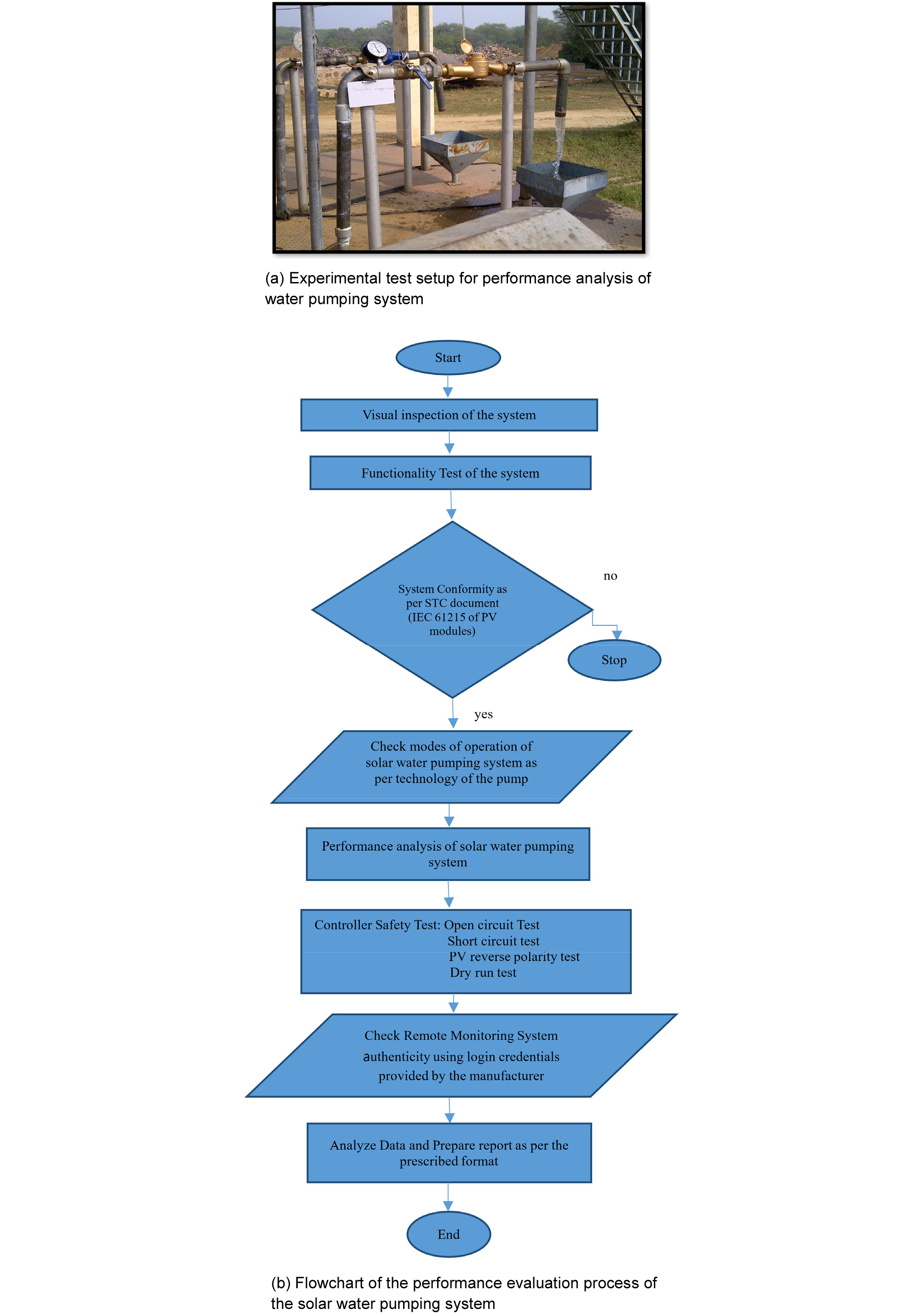
Table 1.
Standards for PV Array
Table 2.
Standards for pumps
Table 3.
PV array capacity and micro pump configuration
Subsystem efficiency is defined as the total hydraulic energy output divided by total PV power input.
Wire to Water Efficiency is defined as total hydraulic energy divided by total power
Flow rate is defined as the water output of the Pump & Motor per unit time
3.2 Selection of the solar water pumping system
Based on study of the pump performance at laboratory, the following parameters were identified as key parameters in context of Indian market: the operating head, total water output required per watt per day, wire to water efficiency and utilization factor. The performance of Surface Pumps was observed to be good for lower head operation whereas, Submersible pumps were observed to perform better for higher head operation. Outcomes of the comparative analysis have been summarized in Table 4.
Table 4.
Comparative analysis between centrifugal pump and reciprocating pump
4. Discussion
A 0.1HP, 80Watt, DC surface pump was analyzed for operating voltage of 12V, 24V and 36V. Figure 7 depicts the estimation of wire to water efficiency with respect to rate of discharge of water and input dc power for a DC centrifugal surface pump at 12V. It has been observed that, at maximum head (22 m), the wire to water (WTWE) efficiency is 42.21% and input power is 39.72W. The maximum WTWE efficiency is observed to be 43.64% @ input power of 37.8W and operational head 20 m. Estimation of wire to water efficiency with respect to rate of discharge of water and input dc power for a DC centrifugal surface pump at 24V is shown in Figure 8 At the maximum head (22 m). the WTWE efficiency is observed to be 46.47% and input power drawn is 44.56W which corresponds to its maximum WTWE efficiency. Fig. 9 records the estimation of wire to water efficiency with respect to rate of discharge of water and input dc power supply for the system at 36V. It is found that at maximum head of 8.5 m, the WTWE efficiency is 46.57% and input power is 76.35W. The maximum WTWE efficiency of 48.97% is also recorded for operational head of 8.5 m with input power of 88.31W due to increased irradiance.
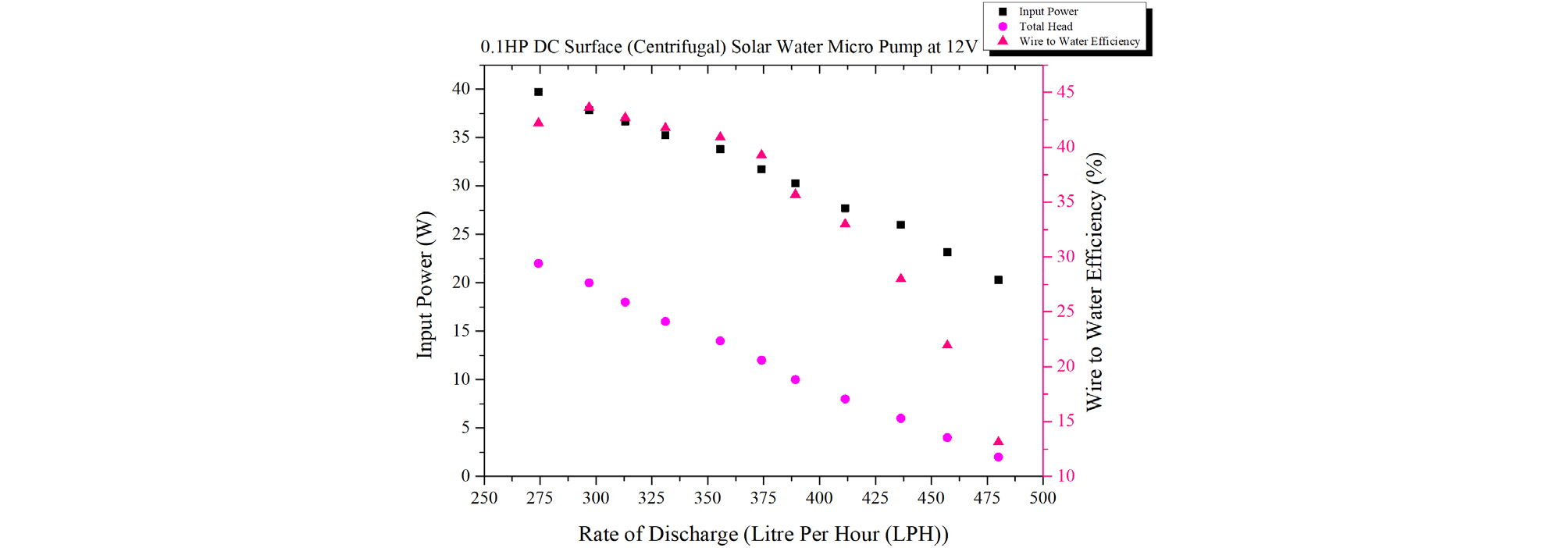
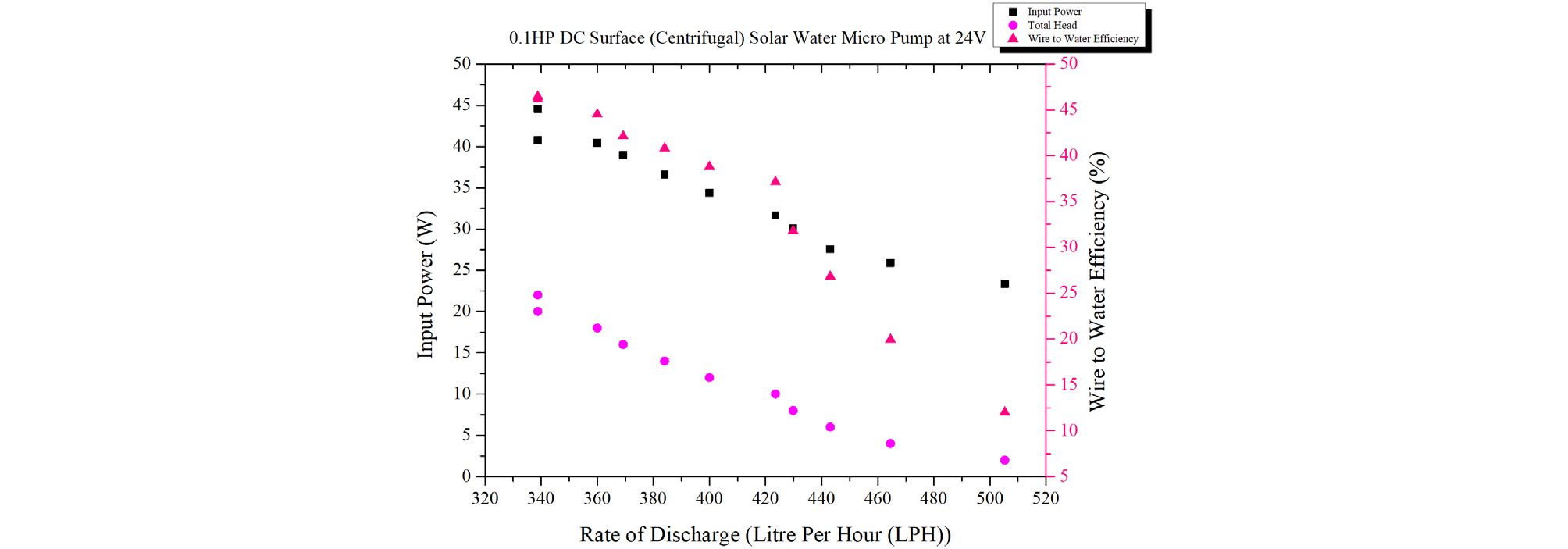
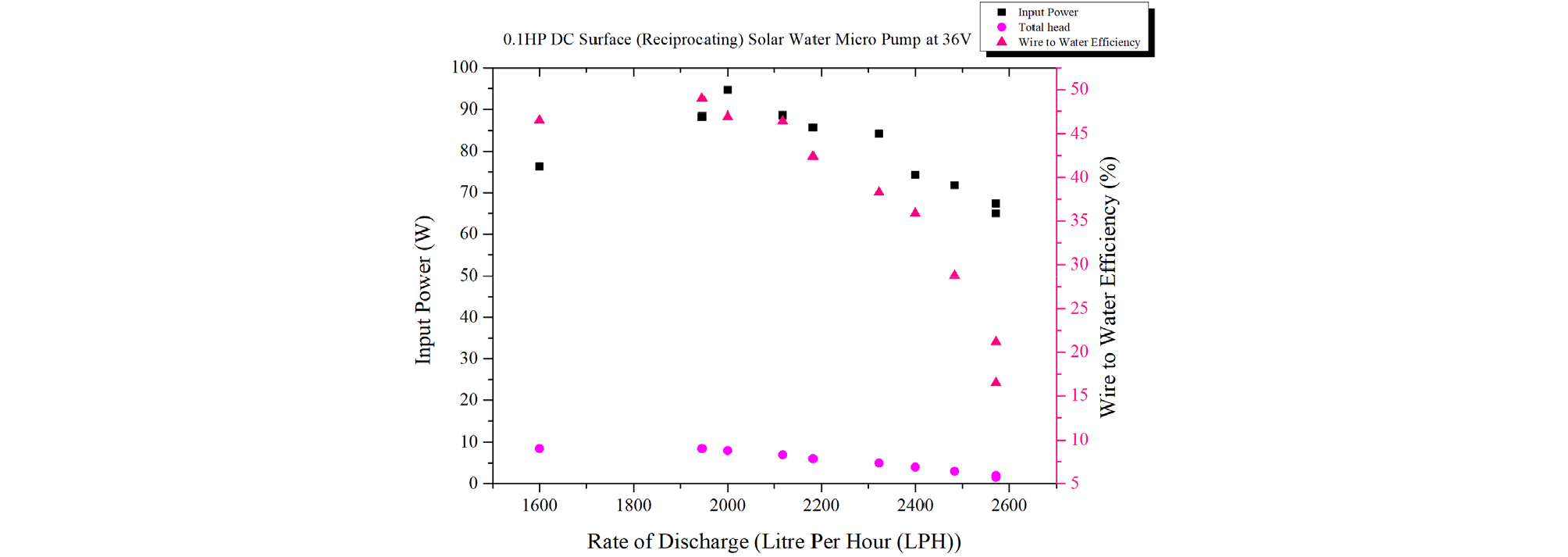
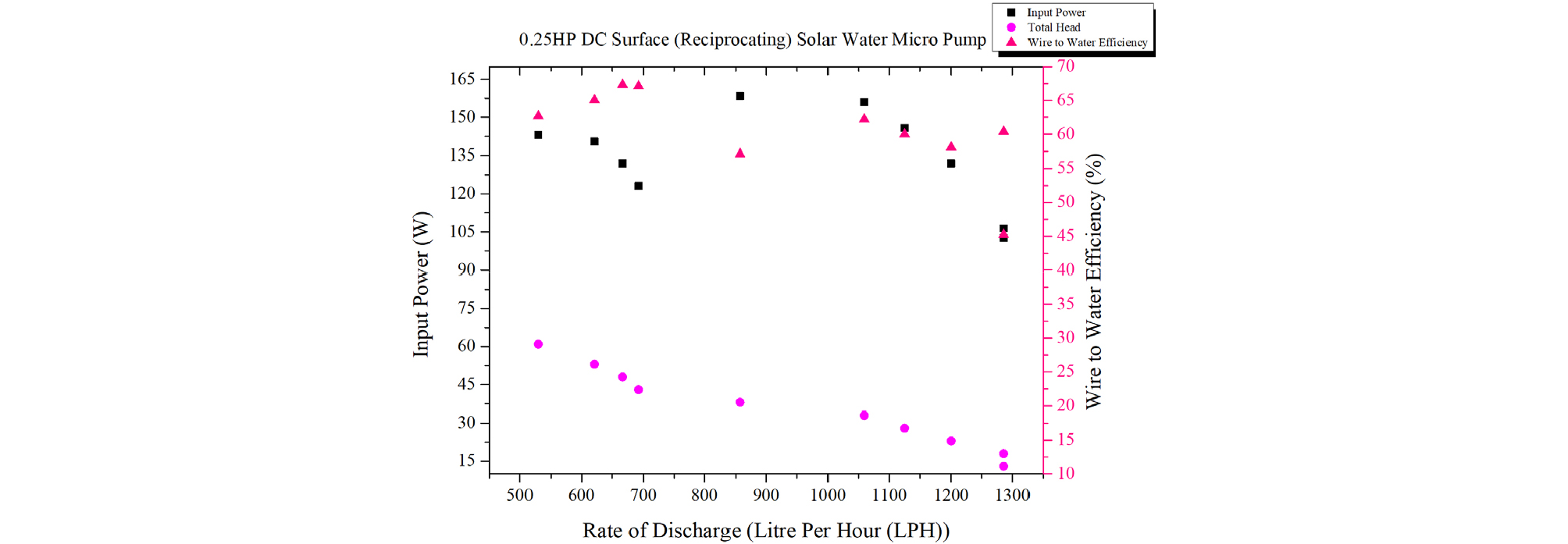
Fig. 10: shows the estimation of wire to water efficiency with respect to rate of discharge of water and input dc power supply for a 0.25HP, DC surface pump. It is found that at maximum head of 61 m, the WTWE efficiency is 62.69% with input power is 143.10W. The maximum WTWE efficiency of 67.86% was recorded with input power of 112W for operational head of 31 m.
5. Conclusion
The work presented in this paper establishes that Solar Water Micro Pumping Systems are portable, easy to use and require less maintenance. The analytical results of different technologies of solar water micro pumps demonstrates performance analysis between centrifugal and reciprocating technologies. Comparative analysis elaborate that reciprocating pumps are more efficient. Although solar water micro pumps are suitable for only limited practices, the observations reveal this configuration being, sustainable and cost-effective method for marginal farmers along with applications like kitchen gardens, farm houses, etc. without the consumption of electricity and conventional fuel, thereby providing a cost-effective alternative.