
Current Photovoltaic Research. 31 December 2022. 116-120
https://doi.org/10.21218/CPR.2022.10.4.116

ABSTRACT


MAIN

  • Nomenclature

  • Subscript

  • 1. Introduction

  • 2. Review of the impacts of solar farms

  • 3. Fence type bifacial photovoltaic farms

  • 4. Future works

  • 5. Conclusions

Nomenclature

PV : Photovoltaics

AV : Agri-voltaic

GISQ : Generic indicator of soil quality

Subscript

cSQ : chemical soil quality

pSQ : physical soil quality

mSQ : microbiological soil quality

1. Introduction

Due to technological developments and helpful government regulations, solar photovoltaics (PV) have recently ranked among the energy technologies with the quickest growth rates1-2). Additionally, it prevents the greenhouse gas effects, air quality issues, and other forms of pollution caused by the usage of fossil fuels3-5). Different methods of deploying PV technology exist. Installing solar panels on the rooftops of homes or businesses is a common strategy. These panels are impermeable panels with PV cells. Ground-mounted solar panel arrays are another method of capturing solar energy, notably on a bigger scale than residential rooftop solar. Solar farms are the popular choice for utility-scale, ground-based solar panel, arrays used to generate energy with a capacity of at least 1 MW6). When constructing a solar farm, the soil surface must be cleared and graded, electrical lines must be buried, vegetation must be removed, and soil compaction increases runoff and erosion. The physico-chemical characteristics of soils were altered by grading, compaction, and erosion thus lowering the quality of the soil4). In a variety of climatic and geographical circumstances, there is a limited but increasing number of scientific studies attempting to comprehend the effects of solar farms, particularly on landscape ecohydrology. We examine the most recent research on how solar farms affect the hydrology of the landscape and associated soil and plant characteristics.

2. Review of the impacts of solar farms

A solar farm in Colorado, USA, was studied and found to have a large amount of soil coarse particle percentage than a neighboring native grassland reference. The variation in soil particle size is probably caused by erosion of the fine particles due to soil disturbance and plant elimination during the solar farm's development phase7). Using an adjusted generic indicator of soil quality (GISQ), comparison research on four different land use types8) revealed that the quality of anthropogenic soils was 1.5 times worse than that of naturally available soils in the field. Joimel et al9). discovered a reduction in physico-chemical quality of soil with an enthronization variation to urban soils from forest, although Joimel et al.10) found no variations in soil’s biological quality. Solar farm installation might degrade soil quality and have an impact on ecosystem processes such water penetration and storage, plant regrowth, nutrient cycling and organic matter. Such land use categories include forest, shrubland, and abandoned vineyards11-15).

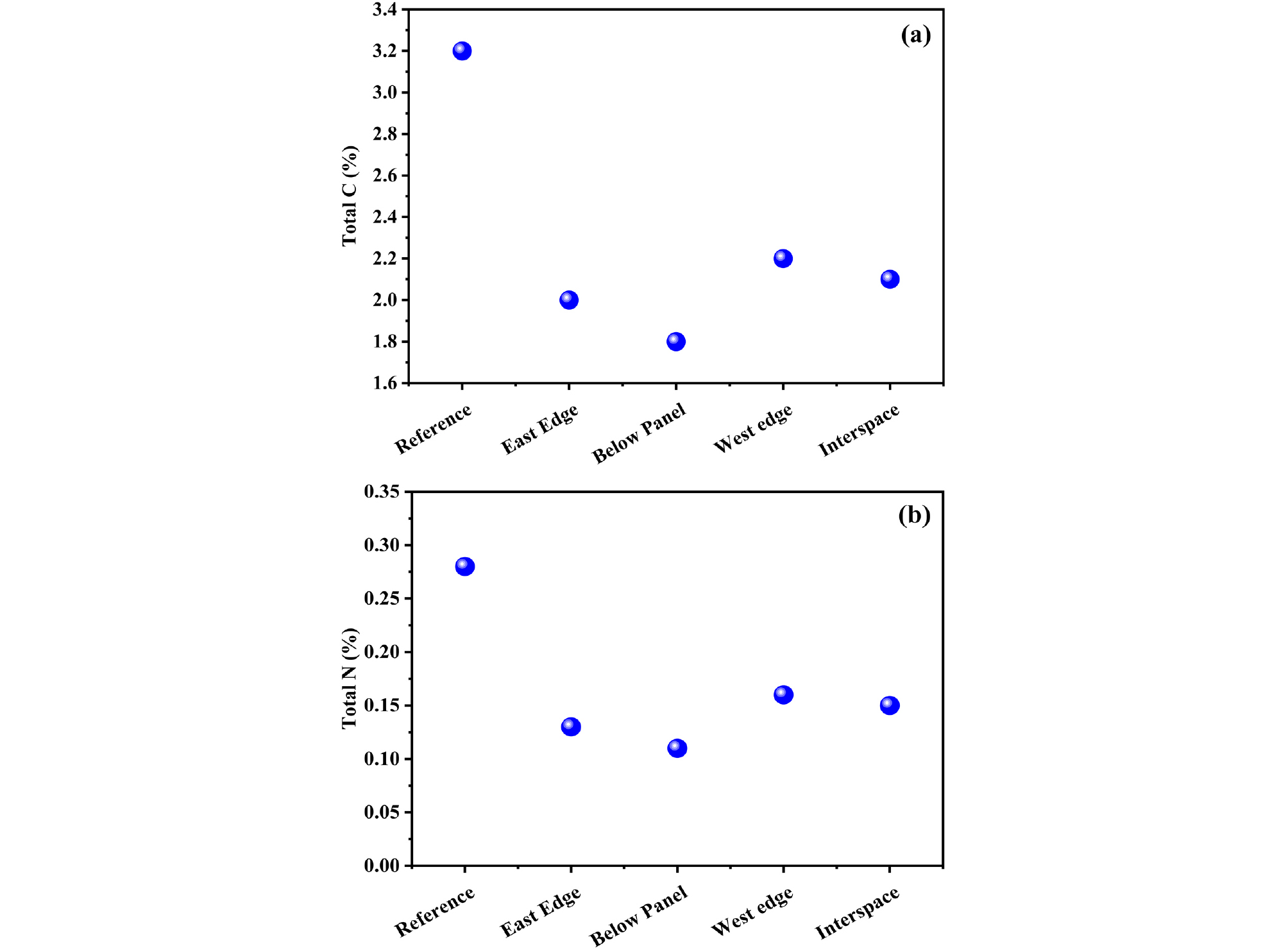
The considerably lower amount of nitrogen and carbon contents in PV soil compared to reference soil were most possibly caused by topsoil exclusion during array installation. With the consistent in addition to other research, which showed decreased into soil organic matter in plant yield output by testing with intentionally removed topsoil to simulate erosion16, 17). Considerably low nitrogen (50%) and carbon (38%) were present in the soil at solar PV location than the reference soil as shown in Figure 1.
https://cdn.apub.kr/journalsite/sites/cpr/2022-010-04/N0170100405/images/cpr_10_04_05_F1.jpg
Fig. 1

(a) the percentage of carbon and (b) the percentage of nitrogen in the soil that serves as a reference and is located underneath solar modules7)

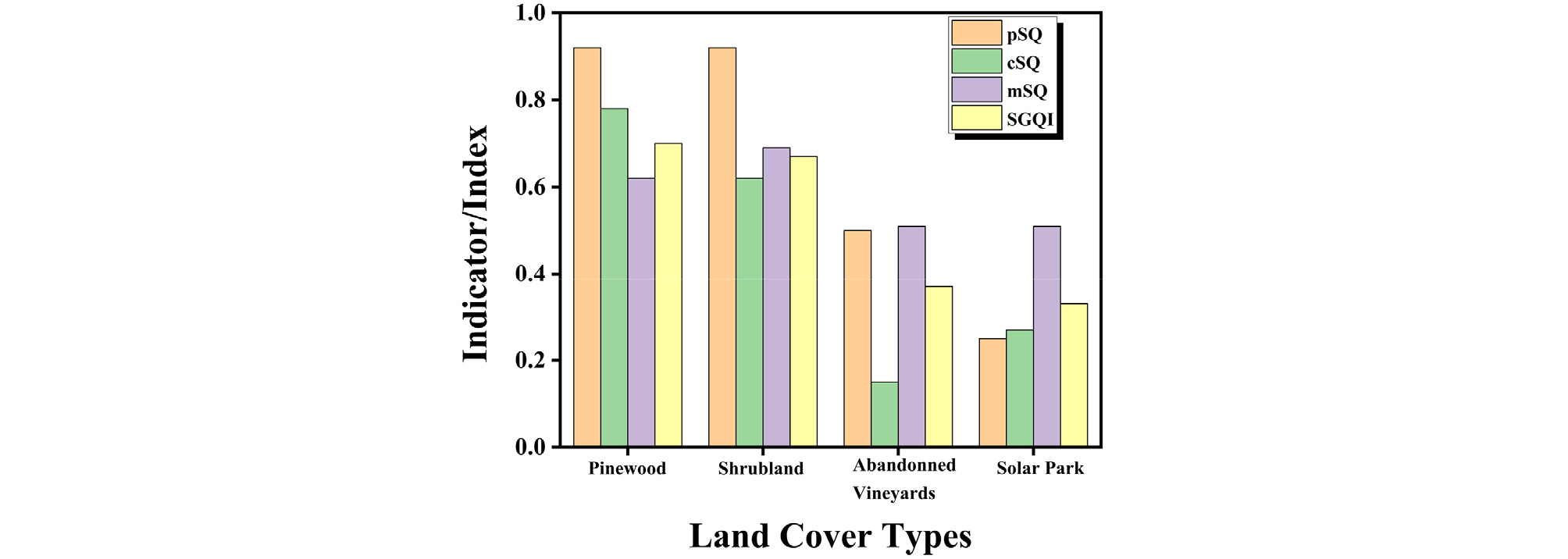
Modeling runoff and keeping track of the effects on microclimate have been the main areas of attention in earlier analyses to check the effects of solar infrastructure on the environment18, 19). For example, according to an assessment, preparation of the location for PV arrays often involves removing plants that deteriorating the soil, which significantly raises onsite runoff and soil erosion20). Furthermore, variations in the topography, vegetation, and albedo might result in higher air temperatures above PV arrays than in nearby natural regions19). The chemical, physical, microbiological sub-indicators of soil quality are denoted as cSQ (chemical characteristics that impact fertility and plant regrowth in solar farms), pSQ (physical characteristics that affect water infiltration and storage) and mSQ (microbiological characteristics that cause decomposition of soil organic matter and nutrient cycling), while general soil quality index is represented as SGQI. In comparison to semi-natural and abandoned vineyards, the pSQ in solar farm was two and four times lower, respectively as shown in Figure 2. The solar farm and abandoned vineyards has a cSQ of 0.18, which was four times lower than the shrubland and pinewood. Figure 2 illustrates that the mSQ did not significantly vary amongst the various land cover categories.
https://cdn.apub.kr/journalsite/sites/cpr/2022-010-04/N0170100405/images/cpr_10_04_05_F2.jpg
Fig. 2

Chemical, physical, microbiological and considering various forms of land cover, a general indication of soil quality4)

3. Fence type bifacial photovoltaic farms

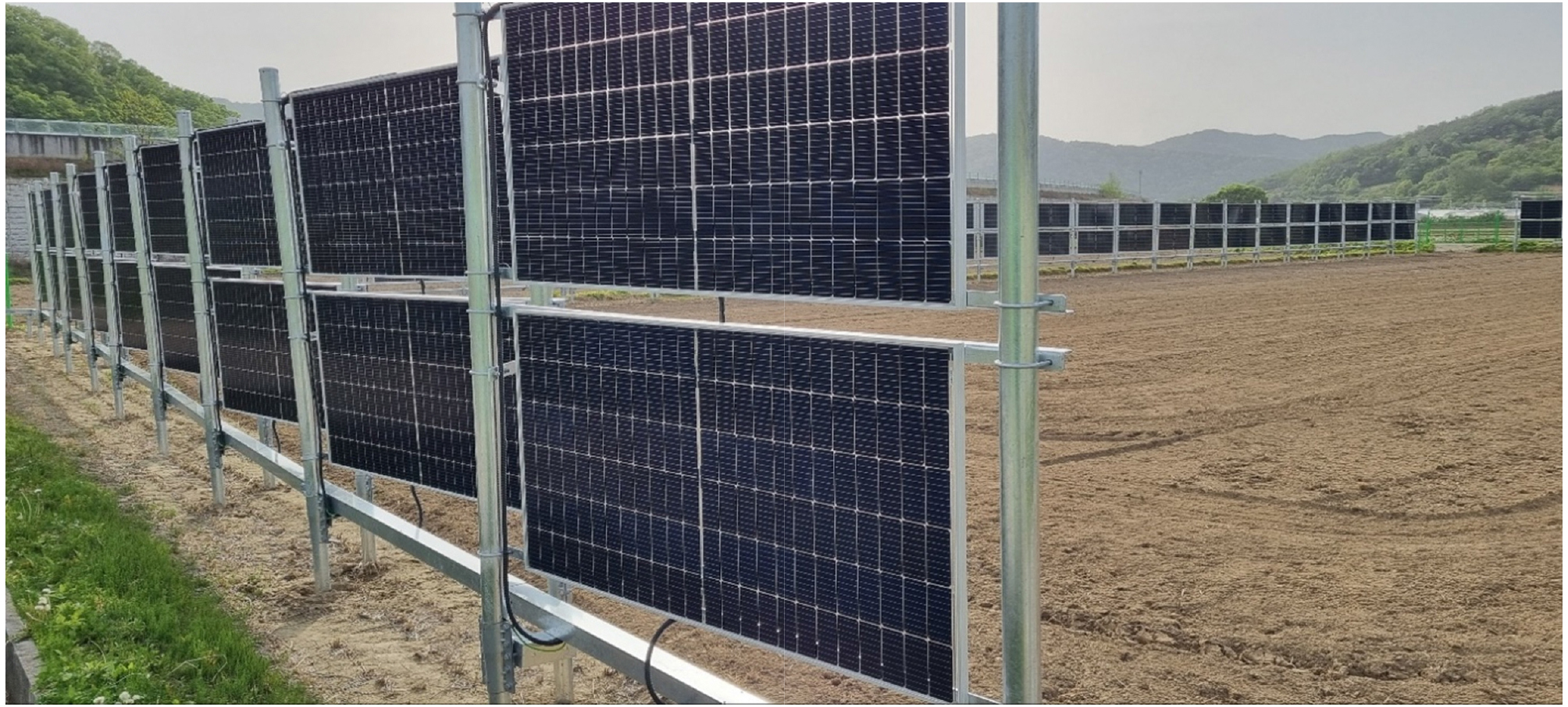
One of the issues with adopting a normal solar array having fixed tilt construction that oriented towards North/South (N/S) for agri-voltaic (AV) farming is geographical diverse in daily sunshine supply for crops and soil water levels, that can impact plant output yield altogether. The research of inclined vertically bifacial AV farms may be appealing in areas with significant PV losses owing to dust. Several research have recently investigated the possibilities of vertical East/West (E/W) faced bifacial PV farms for AV systems. Investigation the possibilities of AV systems using vertical E/W facing bifacial PV farms has been done by Riaz et al.21, 22). In terms of PV energy production and photosynthetically active radiation (PAR), the findings demonstrated that standard N/S facing tilted farms and vertical bifacial farms both performed equally well at half PV array density. An example of on-farm Fence type bifacial PV system is shown in Figure 3. It was discovered that E/W vertical PV farms demonstrated geographical uniformity for crop light among AV farms, but N/S facing PV farms showed longitudinal diversification23). Given that, dust has a low potential to build on vertical surfaces and the vertical tilt is especially well suited for environments with significant dust components24). As the tilt of the PV panel changes from horizontal to vertical, PV soiling (dust formation) losses are known to be significantly reduced25). The area near the structure for mounting that unable be utilized for agriculture around 10% for mounted vertically AV arrangements can be employed as pollinator environment and to improve with agrobiodiversity, which is favorable and benefits for plants output yield26-28) gave a good results thorough examination and issues related to the ideas of the economy, green economy, and bio economy. A realistic nexus model of water-food-energy was built for the modeling and optimization of perpendicularly installed AV systems29).
https://cdn.apub.kr/journalsite/sites/cpr/2022-010-04/N0170100405/images/cpr_10_04_05_F3.jpg
Fig. 3

Application of Fence type bifacial PV system installed at Kyungpook National University’s agricultural field in Korea

4. Future works

Due to the destruction of vegetation and changes to the soil caused by solar park development, a thorough examination of the environmental effect of solar farms is required30, 31).

5. Conclusions

The construction of a solar farm requires the removal of the plants as well as the leveling of the soil field. Solar energy infrastructure may significantly modify the landscape, affecting the hydrologic, carbon, and vegetative dynamics as well as the biological activities that take place in the soil. The particle size variation is most likely caused by erosion of fine particles produced by soil disturbance and plant eradication during the solar farm construction period. The significantly reduced nitrogen and carbon percentage concentrations in PV soil as compared to reference soil were most likely caused by topsoil removal during array installation. The cSQ in the solar farm and abandoned vineyards was 0.18, which was four times lower than the shrubland and pinewood. The mSQ did not considerably differ amongst the various types of land cover. In regions with considerable losses of PV output because of contaminated soil particles on PV surfaces, the study of vertical inclined bifacial AV farms may be interesting. PV soiling (dust generation) losses are known to be greatly decreased as the tilt of the panel changes from horizontal to vertical.


Acknowledgements

This research was supported by the New & Renewable Energy Technology Development Program of the Korea Institute of Energy Technology Evaluation and Planning (KETEP) funded by the Korean Ministry of Trade, Industry and Energy (MOTIE) Grant Nos. 20213030010140. Authors are also acknowledged to Kyungpook National University to provide facility for testing the Fence PV fields.

References

1
US Department of Energy, "SunShot vision study," Washington DC (2012).
2
C, Bogdanov D, Gulagi A, Aghahosseini A, Barbosa LS, Koskinen O, Barasa M, Caldera U, Afanasyeva S, Child M, Farfan J., "On the role of solar photovoltaics in global energy transition scenarios," Prog. in PVs: Res and App, (8), 727-45 (2017). 10.1002/pip.2885
3
Grigorescu I, Vrˆ inceanu A, Vrˆ inceanu A, Dumitra, scu M, Mocanu I, Dumitrica C, Mitric ˘ a B, Kuscicsa G and ˘ Serban P, "Regional, differences in the spatial distribution and environmental consequences of PV farms in southern Romania," Ukrainian Geogr. J., (3), 60-9 (2019). 10.15407/ugz2019.03.060
4
Lambert Q, Bischoff A, Cluchier A, Cueff S and Gros R, "Effects of solar park construction and solar panels on soil quality, microclimate, CO2 effluxes and vegetation under a Mediterranean climate," Land Degradation and Development, (32), 5190-5202 (2021). 10.1002/ldr.4101
5
Vr^inceanu A, Grigorescu I, Dumitra, scu M, Mocanu I, Dumitrica C, Micu D, Kucsicsa G and Mitric ˘ a B, "Impacts of photovoltaic farms ˘ on the environment in the Romanian plain," Energies, (12), 2533 (2019). 10.3390/en12132533
6
Bajehbaj RY, Zaliwciw D, Cibin R, McPhillips LE. "Minimizing environmental impacts of solar farms: a review of current science on landscape hydrology and guidance on stormwater management," Environmental Research: Infrastructure and Sustainability (2022).
7
Choi C S, Cagle A E, Macknick J, Bloom D E, Caplan J S and Ravi S, "Effects of revegetation on soil physical and chemical properties in solar photovoltaic infrastructure Front," Environ. Sci., (8), 140 (2020). 10.3389/fenvs.2020.00140
8
Raiesi F, Salek‐Gilani S. "Development of a soil quality index for characterizing effects of land‐use changes on degradation and ecological restoration of rangeland soils in a semi‐arid ecosystem," Land Degradation & Development, 31(12), 1533-44 (2020). 10.1002/ldr.3553
9
Joimel S, Cortet J, Jolivet CC, Saby NP, Chenot ED, Branchu P, Consalès JN, Lefort C, Morel JL, Schwartz C. "Physico-chemical characteristics of topsoil for contrasted forest, agricultural, urban and industrial land uses in France," Science of the Total Environment, (545), 40-7 (2016). 10.1016/j.scitotenv.2015.12.03526745291
10
Joimel S, Schwartz C, Hedde M, Kiyota S, Krogh PH, Nahmani J, Pérès G, Vergnes A, Cortet J. "Urban and industrial land uses have a higher soil biological quality than expected from physicochemical quality," Science of the Total Environment. (584), 614-21 (2017). 10.1016/j.scitotenv.2017.01.08628129905
11
Khare P, Goyal DK. "Effect of high and low rank char on soil quality and carbon sequestration," Ecological engineering, (52), 161-6 (2013). 10.1016/j.ecoleng.2012.12.101
12
Romero-Díaz A, Ruiz-Sinoga JD, Robledano-Aymerich F, Brevik EC, Cerdà A., "Ecosystem responses to land abandonment in Western Mediterranean Mountains," Catena, (149), 824-35 (201). 10.1016/j.catena.2016.08.013
13
Rutgers M, Schouten AJ, Bloem J, Van Eekeren N, De Goede RG, Jagersop Akkerhuis GA, Van der Wal A, Mulder C, Brussaard L, Breure AM., "Biological measurements in a nationwide soil monitoring network," European Journal of Soil Science, 60(5), 820-32 (2009). 10.1111/j.1365-2389.2009.01163.x
14
Scarpare FV, van Lier QD, de Camargo L, Pires RC, Ruiz-Correa ST, Bezerra AH, Gava GJ, Dias CT., "Tillage effects on soil physical condition and root growth associated with sugarcane water availability," Soil and Tillage Research, (187), 110-8 (2019). 10.1016/j.still.2018.12.005
15
Yin R, Kardol P, Thakur MP, Gruss I, Wu GL, Eisenhauer N, Schädler M., "Soil functional biodiversity and biological quality under threat: Intensive land use outweighs climate change," Soil Biology and Biochemistry, (147), 107847 (2020). 10.1016/j.soilbio.2020.10784732884602PMC7116016
16
Larney, F. J., Li, L., Janzen, H. H., Angers, D. A., and Olson, B. M., "Soil quality attributes, soil resilience, and legacy effects following topsoil removal and one-time amendments," Can. J. Soil Sci., (96), 177-190 (2016) 10.1139/cjss-2015-0089
17
Hölzel, N., and Otte, A., "Restoration of a species-rich flood meadow by topsoil removal and diaspore transfer with plant material," Appl. Veg. Sci., (6), 131-140 (2003). 10.1111/j.1654-109X.2003.tb00573.x
18
Marrou, H., Dufour, L., and Wery, J., "How does a shelter of solar panels influence water flows in a soil-crop system?," Eur. J. Agron., (50), 38-51 (2013). 10.1016/j.eja.2013.05.004
19
Barron-Gafford, G. A., Minor, R. L., Allen, N. A., Cronin, A. D., Brooks, A. E., and Pavao-Zuckerman, M. A., "The photovoltaic heat island effect: larger solar power plants increase local temperatures," Sci. Rep., (6), 35070 (2016). 10.1038/srep3507027733772PMC5062079
20
Cook, P., "Infrastructure, rural electrification and development," Energy Sustain. Dev., (15), 304-313 (2011). 10.1016/j.esd.2011.07.008
21
Riaz MH, Imran H, Younas R, Alam MA, Butt NZ., "Module technology for agrivoltaics: vertical bifacial versus tilted monofacial farms," IEEE Journal of Photovoltaics, 11(2), 469-77 (2021). 10.1109/JPHOTOV.2020.3048225
22
Riaz MH, Imran H, Butt NZ., "Optimization of PV array density for fixed tilt bifacial solar panels for efficient agrivoltaic systems," In 2020 47th IEEE Photovoltaic Specialists Conference (PVSC), 1349-1352 (2020). 10.1109/PVSC45281.2020.9300670
23
Imran H, Riaz MH., "Investigating the potential of east/west vertical bifacial photovoltaic farm for agrivoltaic systems," Journal of Renewable and Sustainable Energy, 13(3), 033502 (2021). 10.1063/5.0054085
24
Younas R, Imran H, Riaz MH, Butt NZ., "Agrivoltaic farm design: Vertical bifacial vs. tilted monofacial photovoltaic panels," arXiv preprint, 1910.01076 (2019).
25
A. Ullah, H. Imran, Z. Maqsood, N. Z. Butt, "Investigation of optimal tilt angles and effects of soiling on pv energy production in pakistan," Renewable energy, (139), 830-843 (2019). 10.1016/j.renene.2019.02.114
26
Dainese M, Martin EA, Aizen MA, Albrecht M, Bartomeus I, Bommarco R, Carvalheiro LG, Chaplin-Kramer R, Gagic V, Garibaldi LA, Ghazoul J., "A global synthesis reveals biodiversity-mediated benefits for crop production," Science advances, 5(10), 0121 (2019). 10.1126/sciadv.aax012131663019PMC6795509
27
Kleijn D, Bommarco R, Fijen TP, Garibaldi LA, Potts SG, Van Der Putten WH., "Ecological intensification: bridging the gap between science and practice," Trends in ecology & evolution, 34(2), 154-66 (2019). 10.1016/j.tree.2018.11.00230509848
28
D'Amato D, Droste N, Allen B, Kettunen M, Lähtinen K, Korhonen J, Leskinen P, Matthies BD, Toppinen A., "Green, circular, bio economy: A comparative analysis of sustainability avenues," Journal of cleaner production, (168), 716-34 (2017). 10.1016/j.jclepro.2017.09.053
29
Campana PE, Stridh B, Amaducci S, Colauzzi M., "Optimisation of vertically mounted agrivoltaic systems," Journal of Cleaner Production, (325), 129091 (2021). 10.1016/j.jclepro.2021.129091
30
Armstrong A, Ostle NJ, Whitaker J., "Solar park microclimate and vegetation management effects on grassland carbon cycling," Environmental Research Letters, 11(7), 074016 (2016). 10.1088/1748-9326/11/7/074016
31
Hernandez RR, Hoffacker MK, Murphy-Mariscal ML, Wu GC, Allen MF., "Solar energy development impacts on land cover change and protected areas," Proceedings of the National Academy of Sciences, 112(44), 13579-84 (2015). 10.1073/pnas.151765611226483467PMC4640750
페이지 상단으로 이동하기