


Nomenclature
Subscript
1. Introduction
2. Materials and methods
2.1 Solar cell and module properties
2.2 Outdoor measurement system
3. Results and Discussion
3.1 Irradiance properties
3.2 Module temperature comparison
3.3 Outdoor performance comparison
4. Conclusions
1. Introduction
Building-integrated photovoltaics (BIPV) have gained increasing attention as a promising solution for on-site renewable energy generation, enabling photovoltaic systems to function simultaneously as building envelope components1, 2). By integrating PV modules into façades or rooftops, BIPV can alleviate land-use constraints and contribute to carbon reduction in urban environments3). However, compared to conventional rack-mounted PV systems, BIPV modules are often exposed to unfavorable thermal boundary conditions due to limited rear-side ventilation, direct contact with building structures, and vertical installation angles4, 5). As a result, operating temperature becomes a critical factor affecting the energy yield of BIPV systems6).
Among various BIPV module configurations, laminated G2G structures are widely adopted in commercial products due to their mechanical robustness, moisture resistance, and architectural compatibility7, 8). While G2G modules provide excellent durability, their thermal behavior under outdoor operating conditions especially in vertically installed BIPV applications has raised concerns, as accumulated heat can negatively affect photovoltaic performance9). Since crystalline silicon solar cells exhibit a negative temperature coefficient, elevated module temperatures can lead to a measurable reduction in power output and energy yield10, 11).
To mitigate thermal losses, several studies have explored thermal management strategies for PV modules, including enhanced rear-side ventilation, radiative cooling, and the use of materials with higher thermal conductivity12, 13, 14). In particular, the application of metal-based rear structures has been proposed as an effective approach to improve heat dissipation15). Steel or aluminum-backed configurations can enhance in-plane heat spreading and thermal radiation, potentially reducing module operating temperature under high-irradiance conditions16, 17). Previous outdoor and laboratory studies have reported that metal-based rear structures or thermally optimized steel components can lower module temperatures by several degrees Celsius, leading to improved electrical performance, especially during high-temperature operation18, 19).
Despite these findings, direct outdoor comparisons between G2G and G2S module structures under realistic BIPV conditions remain limited, particularly for vertical installations representative of façade applications20). Moreover, the time-dependent performance transition associated with daily temperature variation has not been sufficiently addressed21).
In this study, the outdoor performance of monofacial crystalline silicon single-cell mini-modules with G2G and G2S structures is experimentally compared under vertical south- facing installation in Seoul, South Korea. The modules were deployed on a building rooftop and evaluated based on time- resolved energy yield. Special attention is given to the diurnal performance behavior, revealing a crossover in relative energy yield before and after 13:00. While the G2G module exhibits higher energy yield during the morning period, the G2S module outperforms the G2G module during the afternoon under elevated temperature conditions, resulting in a time-dependent crossover behavior in energy yield between the two configurations. These results highlight the importance of rear-side structural design and thermal management in vertically installed BIPV systems.
2. Materials and methods
2.1 Solar cell and module properties
The photovoltaic cells used in this study were commercial monofacial monocrystalline passivated emitter and rear cell (PERC) cells22). The cells had a square format with dimensions of 156 × 156 mm and were fabricated with a five-busbar (5BB) front electrode design. According to the manufacturer’s specification, the cells exhibited a power output of 4.94 W under standard test conditions. All cells were specified as PID-free.
The photovoltaic modules investigated in this study were fabricated as single-cell mini-modules, each consisting of one monofacial crystalline silicon solar cell. Two different module configurations were prepared: a G2G structure and a G2S structure23, 24).
For the glass-to-glass module, 5 mm thick glass was used on both the front and rear sides25). The rear glass was coated to provide a black appearance, representative of typical BIPV aesthetic requirements. In contrast, the glass-to-steel module employed a 5 mm thick transparent glass on the front side, while the rear side consisted of a steel sheet with a thickness of 1.6 mm.
The electrical output of the mini-modules was measured under standard test conditions (STC). The G2G module exhibited a power output of 4.871 W, whereas the G2S module showed a slightly higher output of 4.948 W. When normalized to the nominal cell power, these values correspond to cell-to-module (CTM) ratios of 98.6% for the G2G module and 100.2% for the G2S module. The difference in CTM between the two module configurations is attributed to variations in rear-side optical behavior. In particular, the higher CTM observed for the glass-to-steel module is likely related to enhanced rear-side reflection effects associated with the steel backsheet and its color characteristics, compared to the black-coated rear glass used in the G2G configuration26).
2.2 Outdoor measurement system
The photovoltaic modules were deployed on a rooftop test site in South Korea and installed in a vertical south-facing orientation (Fig. 1). Outdoor performance measurements were conducted over a 12-day period from August 10th to 21st during the summer season.
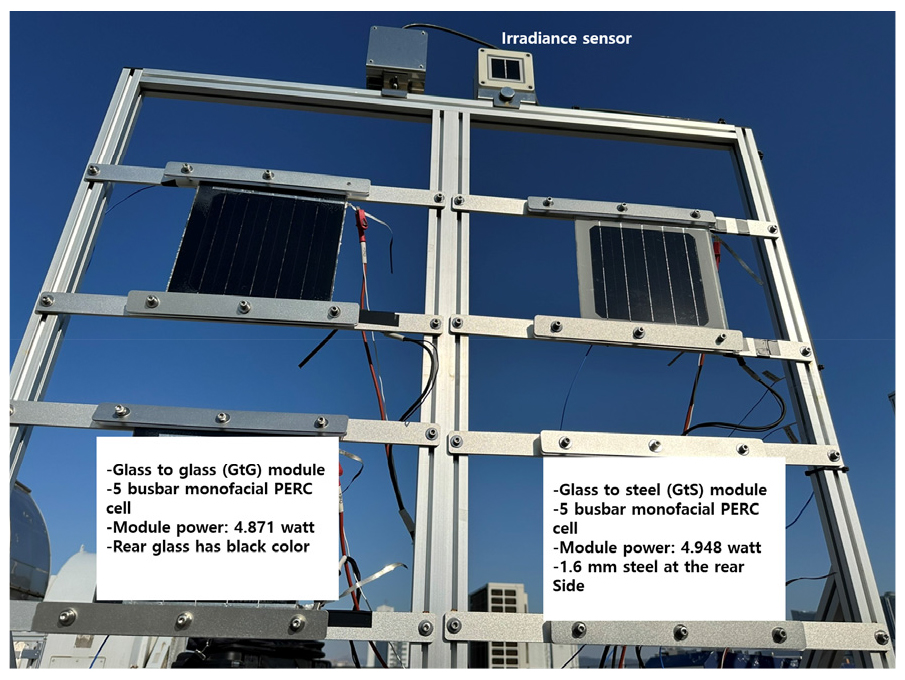
Plane-of-array irradiance was measured on both the front and rear sides of the modules using SOZ-03 pyranometers, while the electrical output of each module was simultaneously recorded. The output power of each module was sampled ten times per hour to capture short-term performance variations under outdoor operating conditions. For photovoltaic performance evaluation, a multi-channel maximum power point tracking (MPPT) I–V tracer was employed. The tracer is based on an electronic load architecture and features four independent measurement channels, allowing simultaneous monitoring of multiple modules. The system supports both I–V sweep and MPPT operation modes, with measurement capabilities up to 150 V and 20 A per channel and a maximum power capacity of 100 W. High measurement accuracy was ensured with a current resolution of 0.1 mA and a voltage resolution of 1 mV. To minimize wiring-related measurement errors, a four-wire (Kelvin) connection method was applied for all module measurements. In addition, the tracer includes a reverse-bias function that enables operation at 0 V, allowing more detailed electrical characterization of the photovoltaic modules under outdoor conditions27).
3. Results and Discussion
3.1 Irradiance properties
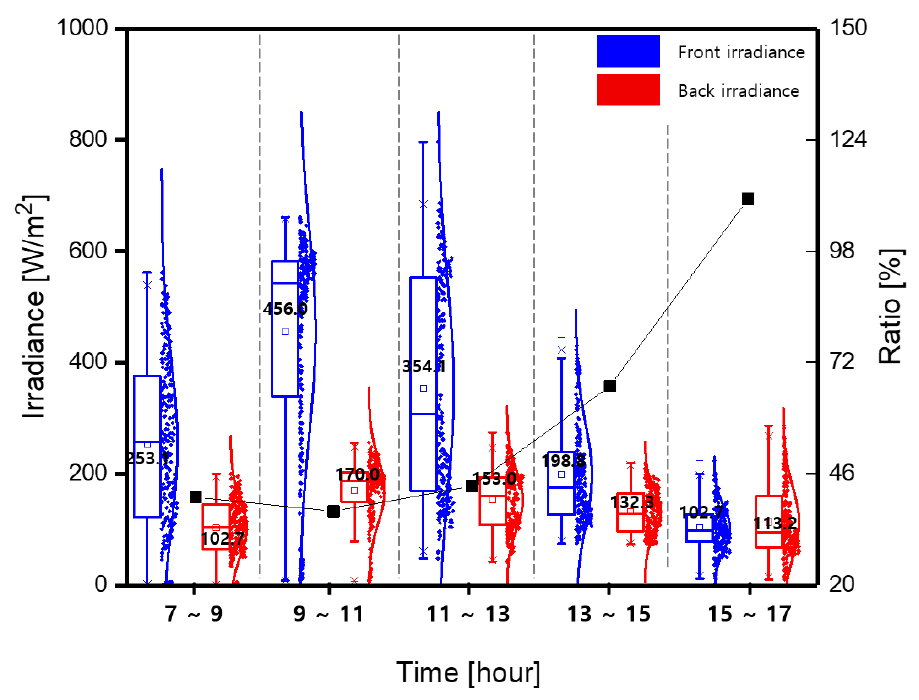
Irradiance measurements were conducted over a 12-day period from August 10th to August 21st, corresponding to mid-summer conditions in the Korean climate. During the measurement period, the photovoltaic module was installed vertically (tilt angle of 90°), and the irradiance sensors were mounted in the same orientation as the module surface to ensure consistent angular response. Irradiance was measured separately on the front and rear sides of the module.
The ratio of rear-side irradiance to front-side irradiance is presented on the secondary axis in Fig. 2, while the absolute irradiance values are shown on the primary axis. The front-side irradiance showed its highest representative value of approximately 456 W/m² between 09:00 and 11:00, after which a decreasing trend was observed throughout the day. This behavior is considered to be strongly related to the vertical installation of the module and irradiance sensor. During the afternoon, the solar elevation angle increases, resulting in a larger incidence angle between the incoming solar radiation and the vertically oriented sensor surface. Consequently, increased optical reflection at the sensor surface is expected, leading to a reduction in the measured irradiance25). In contrast, the rear-side irradiance exhibited relatively small temporal variation during the measurement period. This suggests that the rear-side irradiance is less sensitive to direct solar angle and is mainly governed by diffuse and reflected components, which remain comparatively stable under the investigated conditions.
3.2 Module temperature comparison
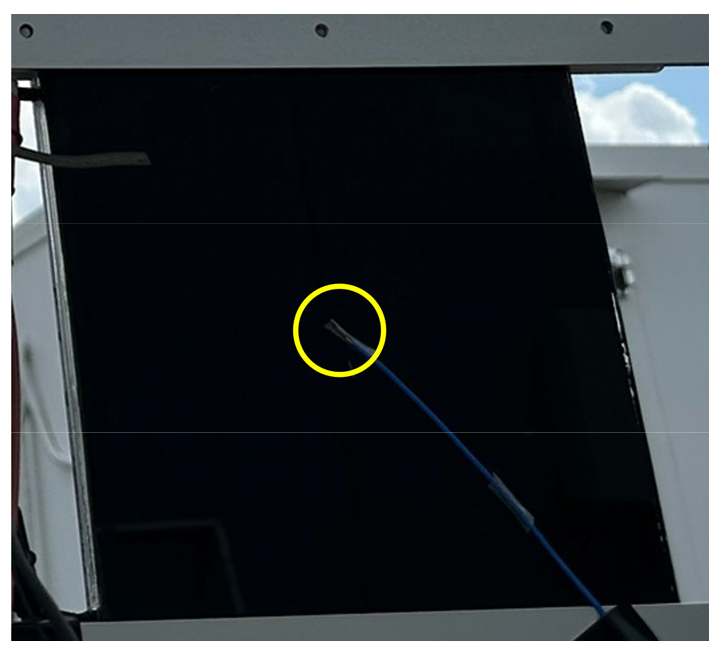
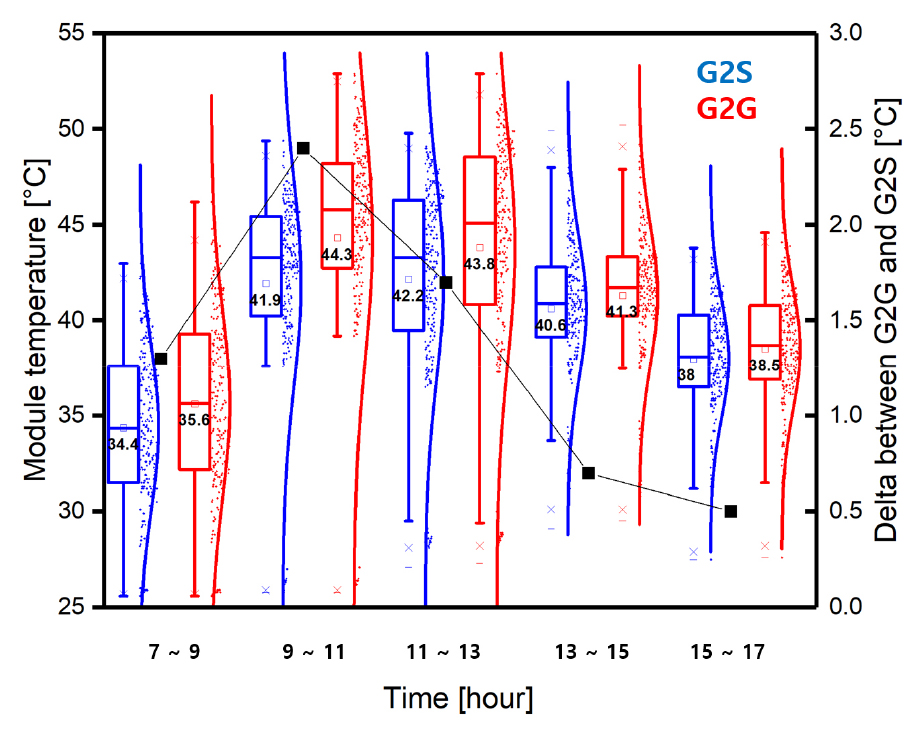
A temperature sensor was attached to the rear side of each module, in close proximity to the cell, as shown in Fig. 311). The rear-side temperatures of the G2G and G2S mini-modules were monitored for 12 days. Temperature measurements were recorded every 5 minute, and the results are summarized as box-and-whisker plots as a function of time.
As shown in Fig. 4, both module configurations exhibited a clear increase in rear-side temperature from the early morning to midday, followed by a gradual decrease in the afternoon. The highest temperatures were generally observed between 11:00 and 13:00, corresponding to periods of elevated solar irradiance and ambient temperature. Across all time intervals, the G2S modules consistently exhibited lower rear-side temperatures compared to the G2G modules. This temperature difference became more pronounced during the midday and afternoon periods, when thermal loading was highest. The median temperature of the G2S modules was several degrees Celsius lower than that of the G2G modules, indicating improved heat dissipation characteristics associated with the steel rear structure28, 29, 30, 31, 32). The temperature dispersion, represented by the interquartile range and whiskers, was also narrower for the G2S modules in several time intervals, suggesting more stable thermal behavior compared to the G2G configuration. These results indicate that the rear-side material plays a significant role in controlling module operating temperature, particularly under high-irradiance conditions relevant to vertically installed BIPV systems.
3.3 Outdoor performance comparison
3.3.1 Normalized Voc comparison
As discussed previously, the G2S modules consistently operated at lower temperatures than the G2G modules during outdoor measurements. Since crystalline silicon solar cells exhibit a negative temperature coefficient for open-circuit voltage (Voc), a reduction in operating temperature is expected to result in an increase in Voc.
This behavior is clearly reflected in the normalized Voc results shown in Fig. 5. Across all time intervals, the G2S modules exhibited higher normalized Voc values than the G2G modules. On average, the normalized Voc of the G2S modules was 1.97% higher than that of the G2G modules. The difference became more pronounced during periods of elevated thermal loading, which is consistent with the larger temperature gap observed between the two module configurations.
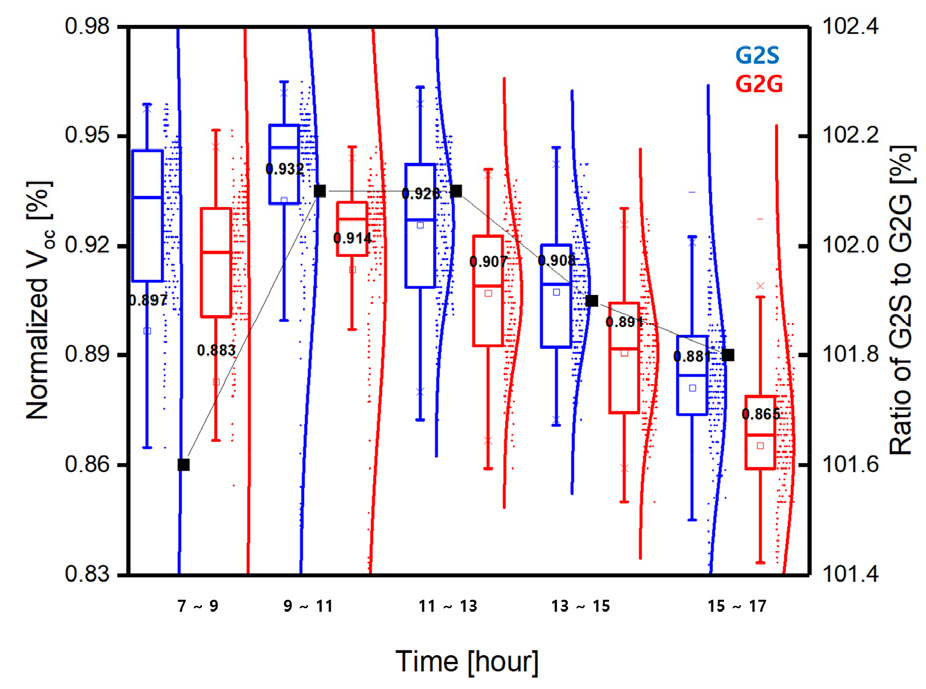
The higher Voc of the G2S modules can be attributed to their lower operating temperature, which reduces intrinsic carrier concentration and recombination losses in crystalline silicon solar cells. This observation is in good agreement with previous studies reporting that reduced module temperature leads to an increase in Voc and improved electrical performance in crystalline silicon photovoltaic modules. Therefore, the enhanced heat dissipation associated with the steel rear structure contributes not only to lower module temperature but also to measurable improvements in voltage-related performance parameters4, 10, 33, 34).
3.3.2 Normalized Isc comparison
Although the G2S configuration operated at a lower module temperature and therefore provided a clear advantage in Voc, the normalized short-circuit current (Isc) of the G2S modules was 2.8% lower than that of the G2G modules (Fig. 6). For crystalline silicon photovoltaic devices, the temperature coefficient of Isc is typically small and positive, i.e., Isc slightly increases with increasing temperature due to bandgap narrowing and related carrier-generation effects4, 10). Consequently, a lower operating temperature would be expected to yield a slightly lower Isc, which is consistent with the direction of the observed trend. However, the magnitude of the measured Isc difference (~2.8%) is substantially larger than what can be reasonably attributed to temperature effects alone, indicating that additional factors governed the photocurrent response in the present outdoor setup4, 10).
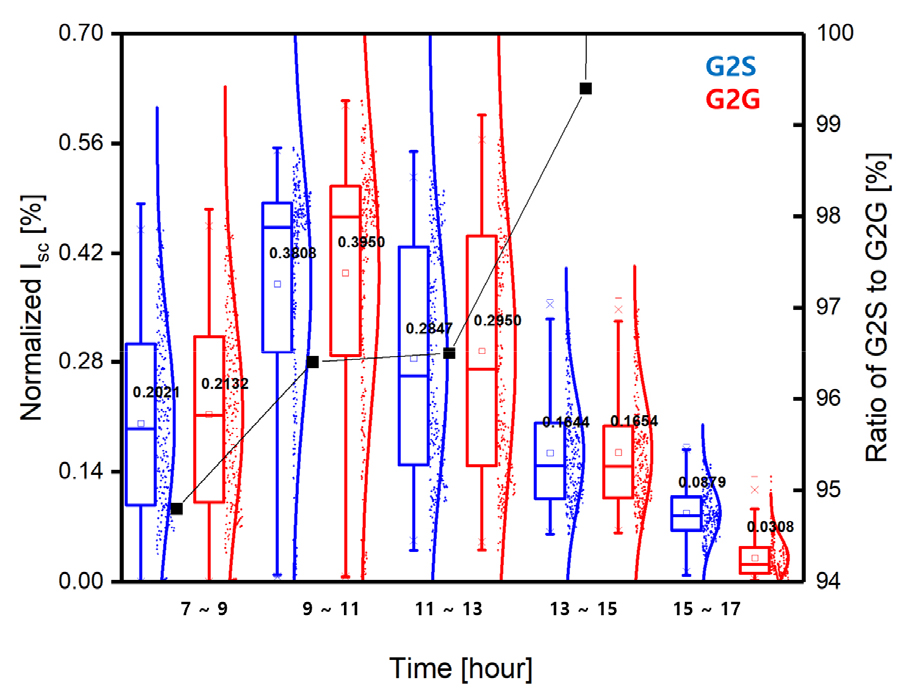
In vertically installed BIPV conditions, Isc is strongly determined by the effective plane-of-array irradiance and by angle-of-incidence (AOI)–dependent optical losses at the module front surface. AOI-related reflection losses are known to increase significantly as the incidence angle deviates from normal, and analytical/empirical models (incidence angle modifier, IAM) have been widely used to quantify these losses for PV modules under field conditions32, 33, 34). Therefore, the lower normalized Isc observed for the G2S modules is more plausibly explained by differences in optical coupling―including AOI-dependent front-surface reflection, transmittance variations associated with the encapsulation/front glass/coating stack, and potential differences in the effective irradiance “seen” by each module plane―rather than by temperature alone32, 33, 34, 35, 36).
3.3.3 Energy yield comparison
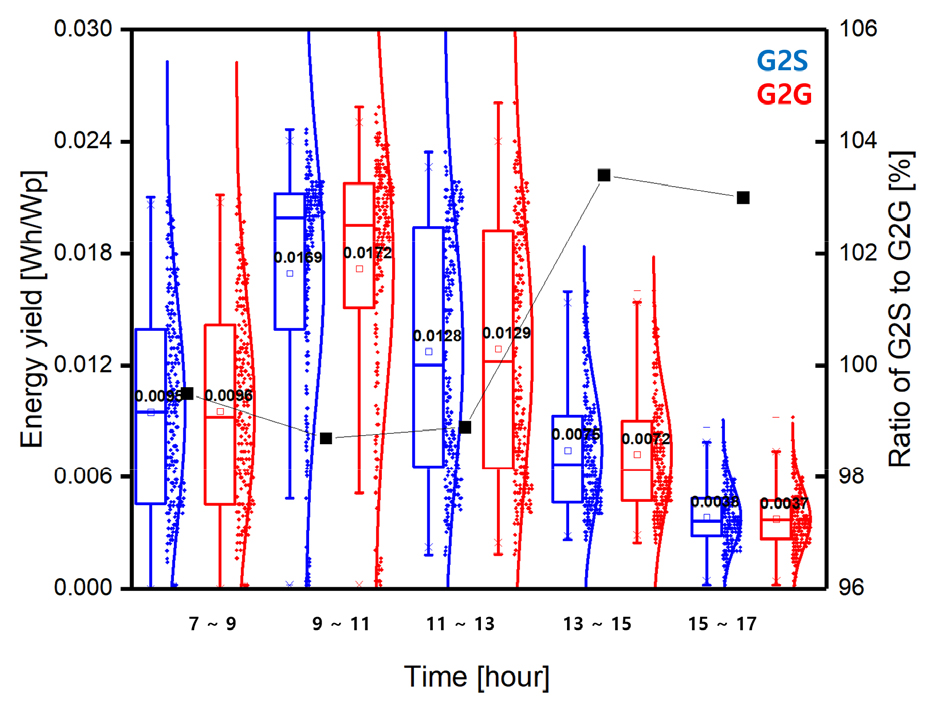
Fig. 7 summarizes the energy yield of the two module configurations as a function of time. Up to 13:00, the G2G modules exhibited a slightly higher energy yield, which can be attributed to their higher Isc under conditions of relatively high irradiance and moderate temperature. After 13:00, however, the trend reversed, and the G2S modules consistently produced higher energy yield. This shift coincides with the period of elevated module temperature and reduced irradiance, during which the voltage advantage of the G2S configuration became increasingly dominant. When integrated over the full measurement period, the cumulative energy yield of the G2G modules was only 0.07% higher than that of the G2S modules. Given the inherent uncertainty of outdoor measurements, this difference falls within the experimental error range, indicating that the overall energy yield of the two configurations is effectively equivalent under the investigated conditions.
4. Conclusions
This study experimentally compared the outdoor performance of G2G and G2S single-cell mini-modules designed for building- integrated photovoltaic (BIPV) applications under vertical south-facing installation in a summer climate. By simultaneously analyzing irradiance, module temperature, electrical parameters, and energy yield, the impact of rear-side structural materials on time-dependent performance behavior was systematically evaluated. The G2S modules consistently operated at lower temperatures than the G2G modules, which resulted in a clear voltage advantage, with the normalized open-circuit voltage being 1.97% higher on average. In contrast, the G2G modules exhibited a higher short-circuit current, with the normalized Isc being approximately 2.8% higher than that of the G2S modules. This behavior indicates a performance trade-off between voltage gains driven by thermal effects and current losses governed primarily by optical and irradiance-related factors under vertical installation conditions.
As a consequence of this trade-off, the energy yield exhibited a distinct time-dependent trend. The G2G modules produced higher energy yield during the morning period, while the G2S modules outperformed the G2G modules during the afternoon when thermal stress was more pronounced. When integrated over the entire measurement period, however, the cumulative energy yield difference between the two configurations was only 0.07%, which falls within experimental uncertainty and indicates that the overall energy yield of G2G and G2S modules is effectively equivalent under the investigated conditions.
Importantly, this equivalence in cumulative energy yield arises from compensating performance mechanisms rather than identical operating behavior.
While the total energy output is comparable, the G2S configuration exhibits enhanced thermal stability during high- temperature afternoon periods, whereas the G2G configuration benefits from higher current output during periods of higher irradiance and lower thermal stress.
Therefore, the potential advantage of the glass-to-steel configuration should be interpreted not as a higher total energy yield, but as improved performance robustness under peak thermal conditions. These findings demonstrate that the selection of BIPV module structures should not be based solely on cumulative energy yield. Instead, climate conditions, installation geometry, and temporal performance characteristics must be considered. While G2G and G2S modules deliver comparable total energy output in the present study, glass-to-steel configurations may offer practical benefits in applications where thermal stability during peak temperature periods is a critical design consideration, particularly in hot climates. This work highlights the importance of time-resolved performance analysis for optimizing BIPV module design and deployment strategies.
This study focuses on summer operation, and the results are therefore representative of hot-climate conditions. Further investigations covering winter and transitional seasons are currently underway to evaluate the seasonal and annual performance characteristics of glass-to-glass and glass-to-steel BIPV modules. It should be noted that the present study employs single-cell mini-modules, in which edge-related heat dissipation may be more pronounced than in full-size modules. While this may affect the absolute temperature level, the comparative trends between G2G and G2S configurations are expected to remain valid. Further investigations using large-area modules are planned to assess scale-dependent thermal effects.